Showing posts with label books. Show all posts

Monday, December 5, 2011

Guadalajara International Book Fair

We just spent a few days over at the Feria Internacional del Libro in Guadalajara. It’s said to be the largest such event in the Western hemisphere (and second only worldwide to the Frankfurt book fair), but I’ve heard that the book fair in Buenos Aires makes the same claim. Anyway, I guess I’ll just have to take the Guadalajara folks’ word for it. It was all slightly overwhelming, all the displays and people. There wasn’t a lot of pulp literature presence, though there were a couple of booths of antiquarian book dealers.


The view on the bus ride to Guadalajara

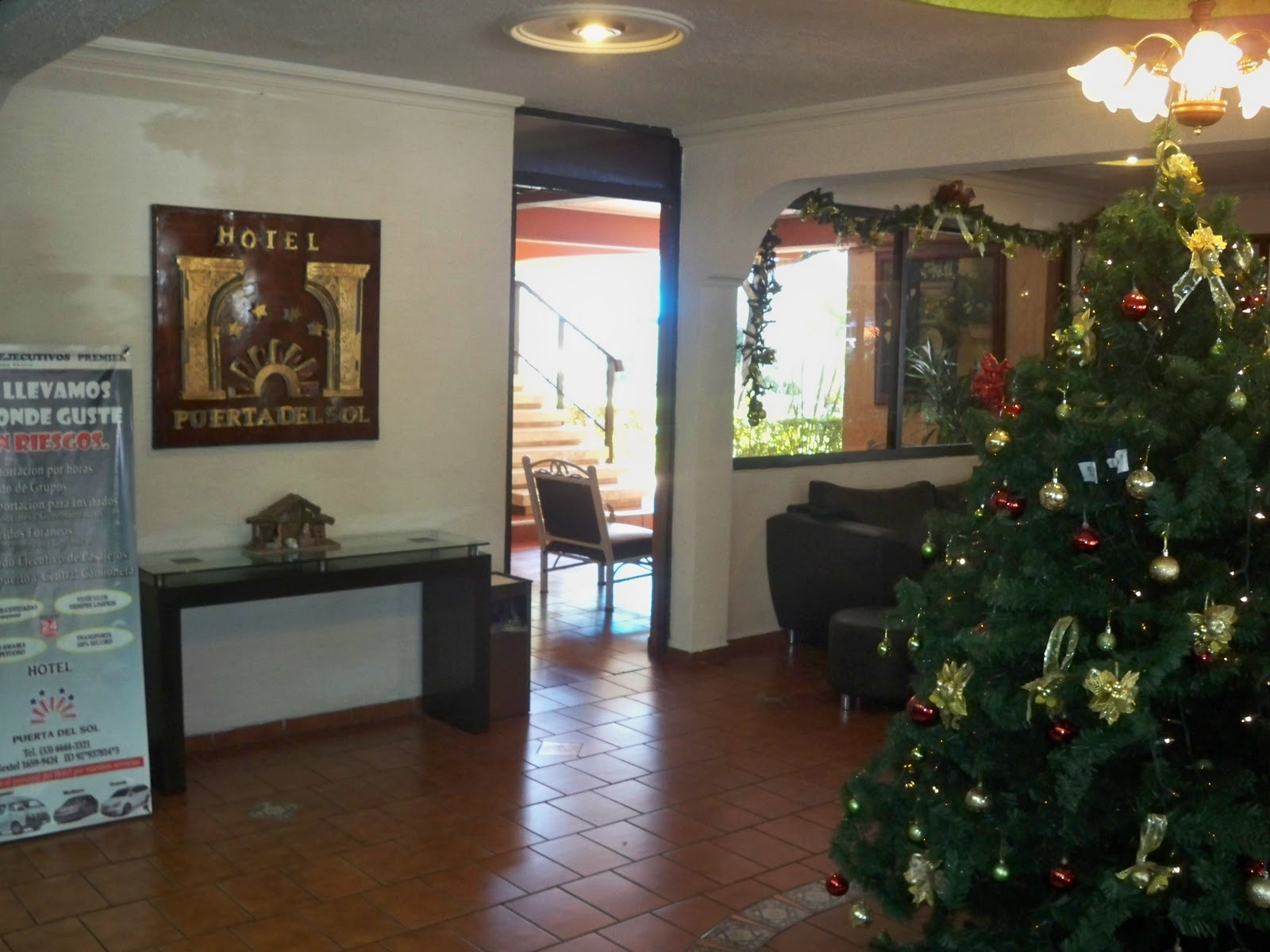
Tropical atmosphere at our hotel, the Puerta del Sol


We went via a bus line called PrimeraPlus, very cheap and actually quite luxurious, comparatively speaking, but a seven hour bus trip is still seven hours. I think I’m basically an air traveller at heart. Our accommodation was the Puerta del Sol, a nice midrange hotel along the lines of an American travel lodge, located about a half mile from the Expo. Its pluses included the pool and spacious rooms. Unfortunately the short time in Guadalajara allowed us minimal opportunities fort sightseeing, so notable attractions like Tonala and Tlaquepaque went unexplored. Next time.


Sunday, August 21, 2011

Mexico City 7 : Bookstores


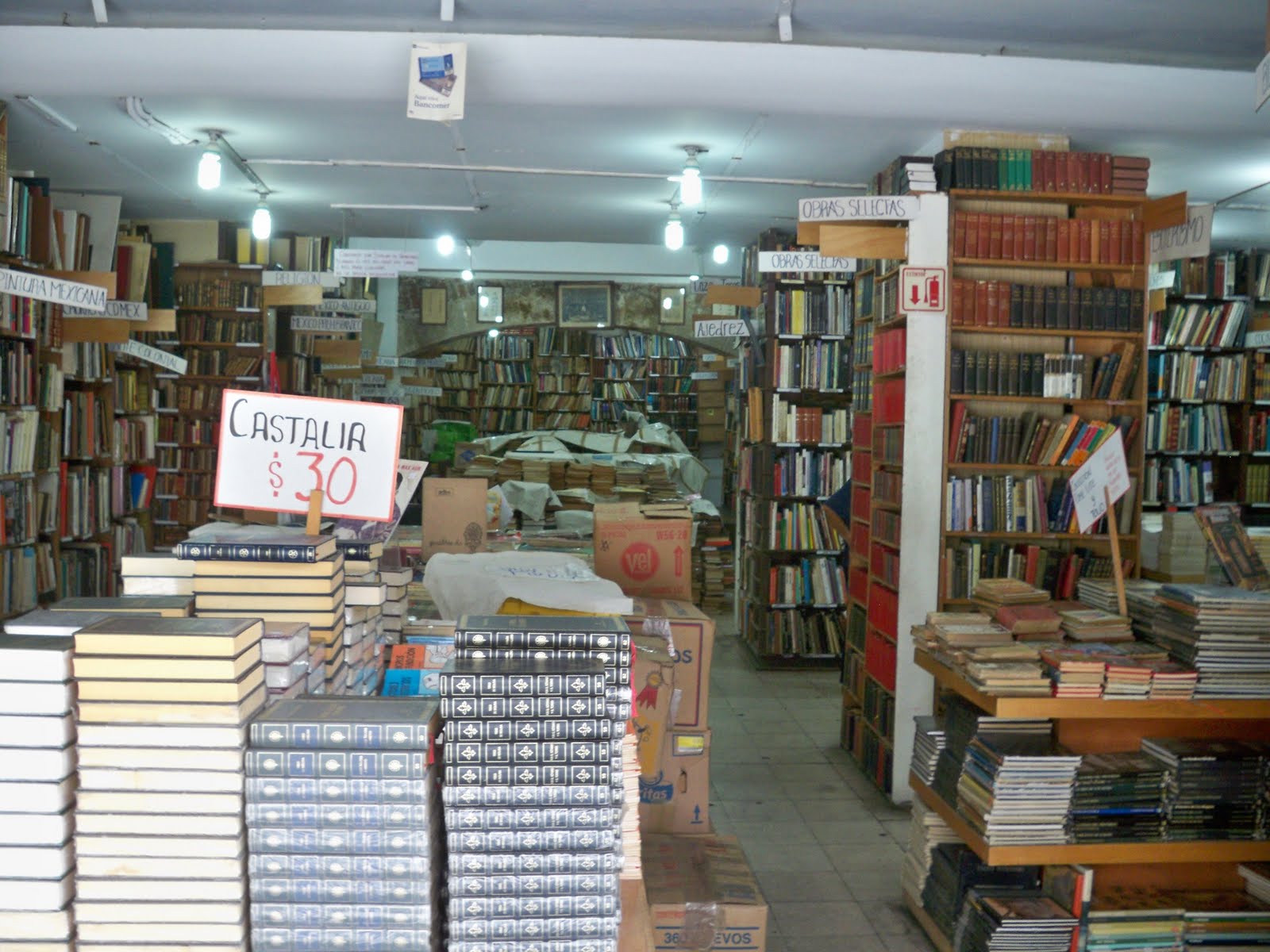
It’s a feast for the bibliophile on Calle Donceles in the Centro district. Located in one of the older sections of the city, Donceles is only about a block from the Zocalo, and it has imposing old buildings, cobblestones and wrought-iron lampposts. Happily, the book shops are clustered together as is the fashion in Mexico City -- there’s a street for perfumes, a street for jewelry, a street for lighting and electrical fixtures, and so on. Even more happily, the Bookstore area on Donceles Steet was not very far from our hotel, maybe ten short city blocks.


These are my kind of bookstores [1], i.e. they are stocked with old, used and musty books, which are varyingly piled on tables; spilling out into the streets; or stuffed onto very high shelves, some which take a 12 foot tall stepladder to reach. The ones piled on the tables are my faves because they are the cheapies!.


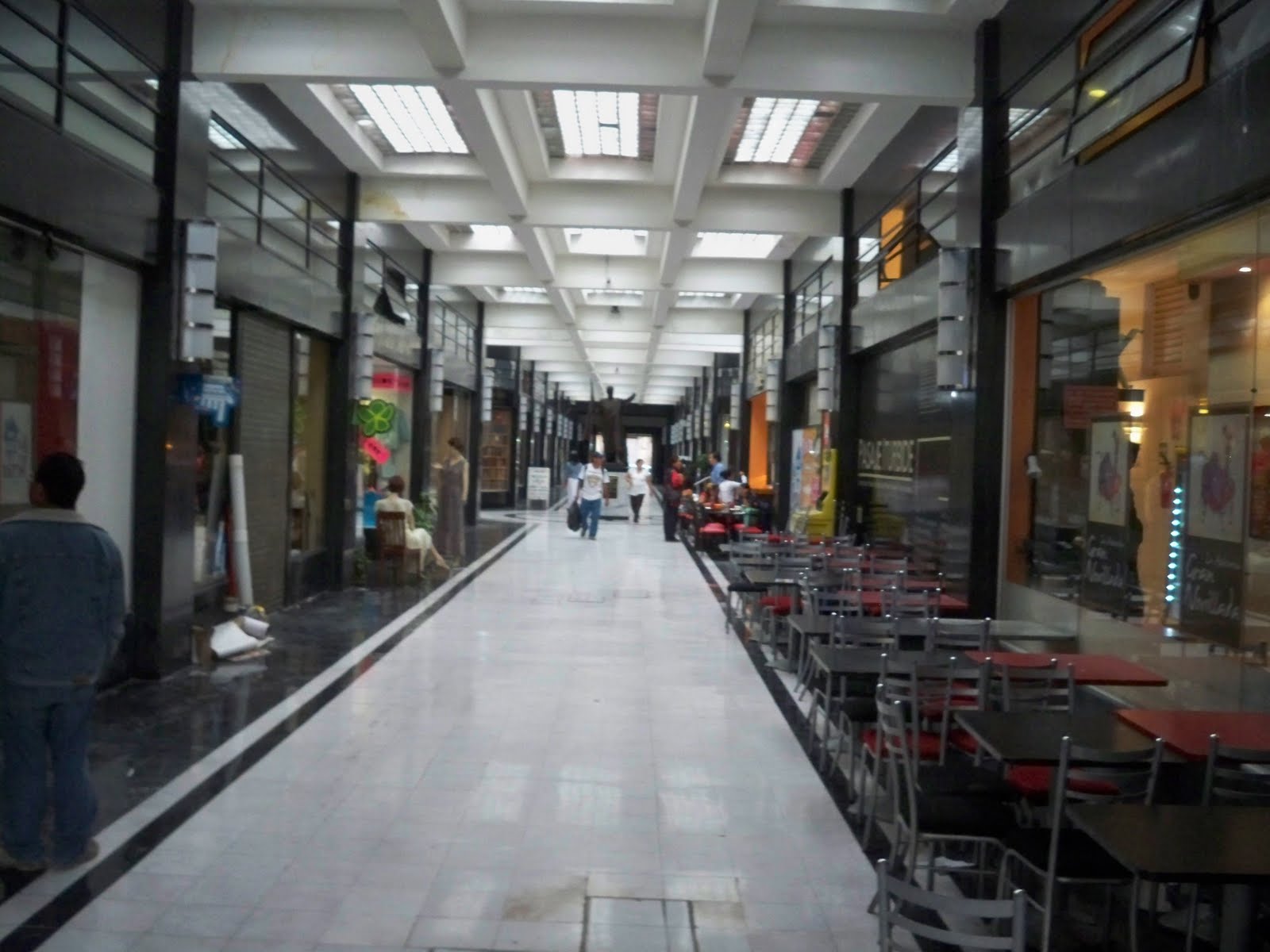
But the pick of the lot may well be a little store in a location not on Donceles Street. The bookstore is the Méjico Viejo, and it’s smaller than the typical used bookstore in Mexico City but much tidier and with a classier, more professional look with two floors of tightly packed antiquarian volumes. Its unlikely location is the Pasaje Iturbe, a commercial indoor mall that runs from one street to another (there’s a Starbuck’s nearby at the corner of Gante and Madero and that was our point of reference which eventually led us to the Méjico Viejo). 

Librería Méjico Viejo. Pasaje Iturbide local 11, sobre calle Gante 6, entre Madero y 16 de Septiembre, Centro Histórico, Del. Cuauhtémoc, México D.F

See also : Kurt Hollander, “Mexico City's Literary Circle,” L. A. Times, 8 Nov 2009; and Browsing the Bookshops on Calle Donceles.
  [1] In Mexico, at least in Mexico City, the bookstores don’t seem to have much of an online presence, not yet, anyway. A few spot searches in ABEBooks limiting the results to a Mexico location yielded nothing. One of the happy results for the collector is that there are bargains to be found in certain specialty areas like pulp fiction and (non-Mexican) antiquarian.


Statue of Augustine de Iturbide
Pasaje Iturbide shops. The Mejico Viejo is 
about half way down on the left.

Saturday, May 14, 2011

Books 2

Another fun discovery, courtesy the good graces of the Mazatlán membership library, is Brian Thompson’s The disastrous Mrs. Weldon : the life, loves, and lawsuits of a legendary Victorian

   As for the book's content I can't offer a lot more beyond the excellent review by Catherine Pope, but an inevitable question that arises is whether the colorful Mrs. Weldon is really enough material for an entire book. Well, probably not, truth be told, but the milieu and atmosphere of Victorian London certainly is, from health food restaurants to the women’s suffrage movement to all the quirky supporting characters, chief among them being the imperious French composer Charles Gounod, a good friend, and more, of our heroine.
   Then there’s an unlikely appearance by Oscar Wilde, who penned a most gracious letter to Mrs. Weldon which probably ranks as the the best commendation she ever received. It’s also refreshing to come across a book on late 19th and early 20th century England in which the dominant artistic persona is not Richard Wagner.
   In an era filled with eccentrics, Georgina Weldon stands out as one of the great undiscovered characters - in all senses of the word - of the of the later nineteenth century.


“At many points while reading this book I actually found it quite hard to believe that it was true. The book read to me more like a Fredrick Forsyth novel than an autobiography of a senior intelligence officer. It is a much better read than fiction as it is written by a man who has been there and done that.”
  -- Peter Hutchinson, Blog About Books, March 29, 2006

I’ve aways liked spy stories both fiction and nonfiction, but my favorites are the tales of real life spies in all their prosaic day-to-day glory. One of the best is Peter Wright’s Spycatcher [1], in which Wright and co-author Paul Greengrass tell a spanking good yarn complete with all sorts of heroes & villains, adventures, tragedy, and sadness.
But there’s humor too, like the Gilbert & Sullivan-esque episode when the über-gay Guy Burgess was ordered by his Soviet masters to woo Churchill’s daughter Clarissa with the eventual goal of marrying her as the perfect cover for his espionage activities. The attempted romance was, comically, and - perhaps for all concerned - mercifully, unsuccessful, and Clarissa eventually married Anthony Eden and became lady Avon. Then there was the Soviet agent ‘Grogovin,’ who was caught literally with his pants down but still refused to come over to the West. He was eventually sent back to Russia and never heard from again. And of course there are lively accounts of  Wright’s encounters with CIA legends William Harvey and James Angleton.
But the crux of the story is Wright’s longtime and ultimately unsuccessful search for a Soviet mole at the highest levels of MI5, the principal candidate being Roger Hollis, Director General from 1956 to 1965. Myself I find Wright’s interpretation of the clues, the connecting of the dots, if you will, convincing. But who knows? And, one might ask, a half century on, who cares? These ruminations aside, Spycatcher can be recommended as a fascinating slice of Cold War nostalgia and sensibilities, organized and told very well. A fun read.


  [1] Since its initial publication Wright’s opus maximus has been much discussed, both pro and con. The unsuccessful attempts in the 1980s by the British government to censor its contents have gained renewed attention in light of the current WikiLeaks phemonenon. For an analysis see Katy Barnett’s Spycatcher and Wikileaks: History Repeats.
    Ideas and theories put forward in Spycatcher have been covered by Chapman Pincher in Treachery : Betrayals, Blunders, and
 Cover-ups : Six Decades of Espionage against America and Great Britain (Random House, 2009), which constitutes a kind of revised and expanded version of Spycatcher. In addition, Wright has been supported by the comments of former MI5 official Stephen de Mobray. Conversely, Wright’s theories have been just as vigorously refuted, a principal example being Christopher Andrew, Defence of the Realm : the Authorised History of MI5 (Alan Lane, 2009). Finally, Paul Monk’s Christopher Andrew and the Strange Case of Roger Holliswhile sympathetic to Wright’s point of view, nevertheless brings a welcome nuance and balance to the debate. See also : Debating the Case of Roger Hollis.


[Thompson, Brian. The Disastrous Mrs. Weldon : the Life, Loves, and Lawsuits of a Legendary Victorian. N.Y, Doubleday, 2001.]


[Wright, Peter. Spycatcher : the Candid Autobiography of a Senior Intelligence Officer. N. Y., Viking, 1987. With Paul Greengrass.]

Monday, April 4, 2011

Books


As I ponder why I brought certain, selected, books with me to Mexico, I don’t really have a good explanation. For whatever reason, various titles had a sentimental significance to me. I seemed to have a special fondness for the coffee-table species; to wit, the very tut-tut British, regrettably little-known Meet You at Raffles. Raymond Flower writes with barely concealed delight and nostalgia for the good/bad old days, presenting us with a popular history of the British Empire’s ultimate colonial hotel.
Flower’s pithy text, permeated throughout by a whiff of British old school superiority and ethnocentricity, is a total delight, but the real highlight of this tome is the collection of vintage photographs from the legendary hotel's glory years. There are pics of golden age and post-modern glitterati like Lord Mountbatten, Grace Kelly, Noel Coward, the cast of BBC’s Tenko, and, of course, the writer virtually synonymous with Raffles, W. Somerset Maugham. Also, building designs, panoramic vistas and more, but especially the plethora of - to current tastes, anyway - rather corny cartoons (maybe you have to be English to get them).

Another title with colonial overtones, Dutch this time (though to be sure the British have their say) is Winchester’s Krakatoa. The book has been praised to the skies [1], thus I have little original to add. However .... perhaps a few observations are in order. 
To begin, this book was admittedly not part of my personal collection but rather came my way through the good graces of the Mazatlán membership library, where I’m fortunate enough to have a subscription membership which entitles me to borrowing privileges. Anyway, I had already read Krakatoa a couple of times, sort of -- listened to, to be exact, a books on tape version which had the added benefit of the author’s mellifluous narrator’s voice.
But one of the mixed joys of the written version are the many footnotes which, as I recall, are omitted from the tape format. They give us a wealth of [almost too much] detail but they tend to interrupt rather than illuminate the narrative. Another minor quibble is that the author goes rather heavily into the technical aspects of geology. 
But ultimately one mustn’t grumble; the benefits include the very same detail, elegantly presented in smoothly flowing prose. Indeed, few books have so much texture, and many are the historical, cultural, scientific, political, and yes, even spiritual confluences and connections, in sometimes unlikely places. By way of two examples : erstwhile pulp author and movie tie-in specialist Michael Avalonne turns up as the author of the book which was adapted into the infamous 1969 film version Krakatoa: East of Java [2].  Also, by felicitous coincidence, I had the luck of a chance viewing, on the Ultimo network, of Krakatoa : The Last Days, the much less well known, but, in this writer’s estimate, far superior BBC sibling to the aforementioned Krakatoa, East of Java. The later film has a great dignity and authenticity, providing a harrowing flavor of how things must have been in and around the erupting volcano. Its special effects are pretty good too.


Another Mazatlán Library discovery, and a happy one at that, is Tony and Maureen Wheeler’s Unlikely Destinations : the Lonely Planet Story, which chronicles the improbable rise of a seat-of-the-pants publishing concern to a multi-billion(?) dollar company and arguably the world’s premier travel publisher. Among the joys of the present volume are the many color photographs and the fluid, non-pretentious writing style. But a particular pleasure for me was the memories of my own, idiosyncratic travels in Southeast Asia some quarter century ago [3], and especially relating to the book’s descriptions of similarly traversed locales. Sometimes even the same hotels showed up [4].
A minor weakness is that the book omits two features which are always strong in the Lonely Planet publications, an index and recommended readings. There’s also a paucity of maps. It all leaves one wondering how much editorial control the authors ultimately had over the final product.


[1] But even the most perspicacious of reviewers couldn’t have anticipated all the recent geologic goings on in Chile, New Zealand, Japan and elsewhere. Thus the text has a remarkable timeliness and prescience -- or does it? Author Winchester might argue that those in the tectonic know can always predict these things (up to a point), in the sense that they are ongoing and are bound to happen eventually. Geologic business as usual, so to speak. It’s just the where and when of very specific events that elude us. 
[2] It’s a little unclear whether the novel was written before, during or after the release of the film. And yes, it’s been much pointed out that Krakatoa is geographically east of Java. Finally, to be fair, a glance at Amazon and IMDB does reveal that the film indeed has its partisans, with particular praise going to the special effects.


[3] An Australasian variant of the Hippie Trail, if you will.


[4] A particularly memorable example being the infamous Chunking Mansions in Hong Kong.

[Flower, Raymond. Meet You at Raffles. Singapore, Kuala Lumpur : Times International Books. Revised edition, July 1987. First published in 1985 as Year of the Tiger. Author Flower’s loving tribute to the legendary hotel. Includes many vintage photos].


[Winchester, Simon. Krakatoa : the Day the World Exploded, August 27, 1883. NewYork :  Perennial Edition, 2004. Originally published in Great Britain by Viking, 2003]. 


[Tony and Maureen Wheeler. Unlikely Destinations : the Lonely Planet Story. Singapore : Periplus, 2005. Distributed by Tuttle Publishing. "How two backpackers trekked across Asia-- and revolutionized the world of independent travel"--Cover].