Friday, August 12, 2011

Mexico City 3 : Museums

Mexico City has an incredible variety of museums and other historic buildings; the ones we didn’t get to would be respectable choices for any number of visits. 
To our credit we did manage to visit the most famous sites : the Museo Nacional de Antropología, the Palacio Nacionale (a kind of museum), the Carlos Slim Museo Soumaya, the Castillo at the Bosque de Chapultapec. These won’t be get a posting in these pages as they are quite well known and well covered in the literature, both online and print. Two big favorites, well known or not, which will receive separate postings in the future will be the Blue House and the nearby Trotsky House. Likewise for the incredibly beautiful Palacio de Bellas Artes, another kind of museum.
But still there are a few under the radar items which merit a mention, pictures of which are included below : the Museo Nacionale de Arte, which despite its rather grand title seems to be one of the lesser known of the city’s major historic buildings. Our highlight there was a Saturday afternoon concert by Mexican pianist Aquilles Morales in the second floor room (I don’t recall its exact name) which is larded with its irresistibly excessive Baroque/Art Nouveau frescos. Anyway, it all made for pleasantly reverberant acoustics for the likes of Debussy, Chopin, Albéniz et al. 
There was also : the Folk Art museum (Museo de Arte Popular), an underrated gem with : incredible carvings of miniature figures, a jaguar sculpture, a psychedelic VW bug, and all sorts of other amazing stuff; the disappointing Carlos Monsivais museum (Museo Estanquillo), disappointing because only one floor of four was open to the public; the funky Museo Policia which had a creepy mujeres asesinas exhibit; the Guggenheim-esque Museo de Arte Moderno, which has a fabulous collection of modern art but is probably best known as the home of The Two Fridas. 
I also include here a few pictures of La Opera Bar restaurant,* Sanborns (aka La Casa de Los Azulejos), and the Hotel Majestic, all historic buildings though technically not museums.

Museo Nacionale de Arte


Museo de Arte Popular


The end for Pancho Villa


Museo del Policía


Museo de Arte Moderno


Mathías Goeritz, El Cuadro de los cuadros


Javier de la Garza
Aparición de la Papaya


Juan O'Gorman, Autorretrato mútiple 
(Multiple self-portrait)


  [1] Our experience at the Opera was very positive, and belies their spotty reputation for overpriced menu items and arrogant, bad service.

Wednesday, July 27, 2011

Mexico City 2 : Pedro Infante and Mexican soccer

One of the seemingly inescapable, if dubious, pleasures of traveling and staying in a decent hotel is the sampling of cable TV offerings in the hotel room during breaks in the  sightseeing routine. In our case it was the same country (Mexico) but different channels, a welcome change as our cable package at home is very basic, in fact it’s called Basic Cable.


Anyway three of our favorites were the Tour de France on ESPN (though not particularly germane to our discussion here); Mexico playing in the U17 world soccer championships; and catching a Pedro Infante movie, on Galavision, I think it was. In many ways the Mexican soccer team winning the world U-17 title was the best story. My knowledge of soccer (or fútbol as they call it here and just about everywhere except in the USA) is about a step lower than my knowledge of rugby, which is almost zero, but that didn’t prevent me from rooting for the home team and thrilling to their success, whether it was the film Invictus or in this case the Mexican team playing on the world stage, albeit with the advantage of home field. In particular Mexico’s improbable come from behind victory in the semifinals against Germany, scoring two seemingly impossible goals in the closing minutes, made the finals win over Uruguay mostly anti-climactic as it was more or less inevitable. Anyway the city and country in general went nuts over the wins and there were parades and celebrations.
Way to go, Mexico!
Another very different type of [guilty] pleasure is watching Mexican golden age movies, and I was fortunate to catch a Pedro Infante movie, one of his last, the immensely enjoyable if eminently lightweight Palbo y Carolina. Who cares if the film was quintessential 1950s fluff about mistaken identity and other goings on? There were the usual Infante songs along with a fetching co-star that I’d never heard of named Irasema Dilián to more than make up for plot and sensibility shortcomings.

Tuesday, July 19, 2011

Mexico City 1 : Arrival

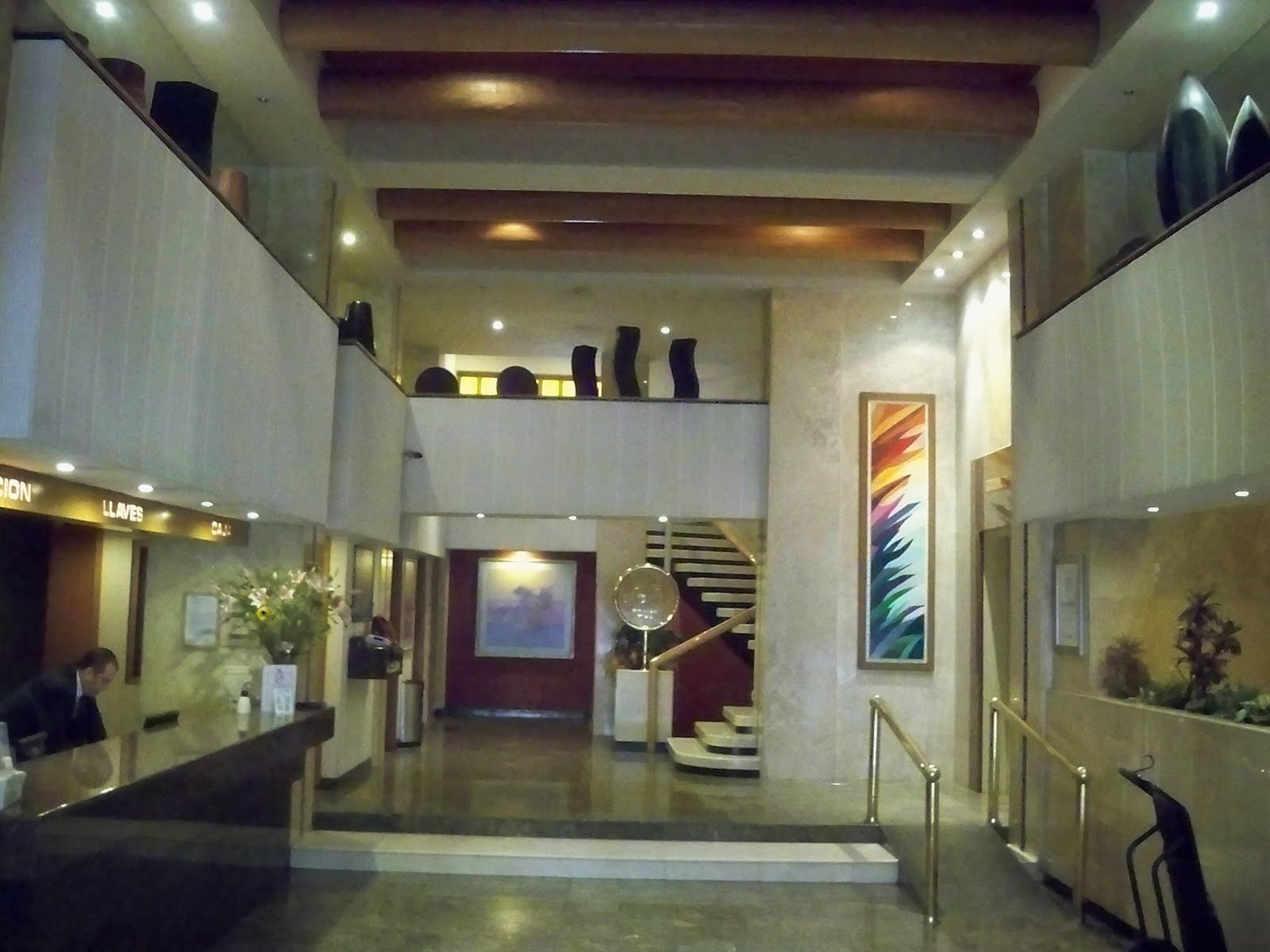
Out first visit ever was a pleasant one, even memorable at times. Since Mexico City must be one of the most written about and photographed places in the world it’s a challenge to find something original to say about it. Thus I’ll do my best to post thoughts on topics and places which aren't so well covered in the literature. But first to begin at the beginning -- we stayed at the Hotel Marlowe in the Centro/Reforma District on Calle Independencia, about 2 blocks from the historic Alameda Park and the Palacio de Bellas Artes. 


Even the art is classy at the Marlowe


The Marlowe gets glowing reviews in the travel sources and indeed it lived up to its billing. Location is first class; the restaurant is great if a tad expensive; the only criticism is that it’s not very close to the metro stops, but then again not really very far away either. Its cleanness and superior management & upkeep combine to give the impression of a mini-Hilton for a third of the price. With the Expedia package we got for a 16-day stay it was a bargain indeed.


However . . . . a budget hotel is still a budget hotel, and the Marlowe, for all it’s great features, lacks some of the basic amenities of the best budget and mid-range hotels in the states; there's no clock radio, free breakfast, refrigerator, microwave, envelopes, writing paper, pencils, coffee maker, or pool. But on the other hand the complimentary apples in the lobby in the afternoons were a nice touch. 

The Pastelria Ideal just down the street.

Do we know this place?
Marlowe also gets high marks for the helpful and knowledgable though not overly personable staff, and for the superior maid service.* And despite the lack of air conditioning, the city’s San Francisco/Seattle-like climate, along with the fan, kept things comfortably cool in our room, although it did tend to get a bit stuffy during the day. Overall I’d rate the Marlowe about 4 stars out of five.


Street performers are popular


A view of the world


* Oops! almost forgot -- watch out for the laundry service, available upon request at the front desk. Our bill was $523 MX pesos, about $45US at the time, for a very modest batch of laundry which would have cost us at most about $10US in our home city of Mazatlán. 

Tuesday, June 21, 2011

Parroquia Cristo Rey

Today we took a walk over to the Parroquia Cristo Rey, which we affectionately call 'the blue church.' It's located at Calle Cañonero Tampico y Germán Evers, in the Centro (more or less) district in Mazatlán. We'd viewed it many times from our bus rides; it's also visible as a distinct silhouette on the MZ skyline anywhere from a high vantage point. Unfortunately it tends to be overshadowed by the cathedral in the main plaza in Centro and is not otherwise on the usual tourist routes. Anyway we finally got there and took a few pictures. Alas, it was all closed up and we couldn't get inside to take some more pics. Next time ..... 


Sunday, June 5, 2011

Plazuela resplendent


The Plazuela Machado in El Centro, already one of the more photogenic of all tourist sites in Mazatlán, recently has the double benefit of some general facelift work and blossoming of some exotic trees, all of which make the area even more magical than usual. (I’m sorry that I don’t know the name of the trees). Here then are a few recent photos.


Saturday, May 14, 2011

Books 2

Another fun discovery, courtesy the good graces of the Mazatlán membership library, is Brian Thompson’s The disastrous Mrs. Weldon : the life, loves, and lawsuits of a legendary Victorian. 

   As for the book's content I can't offer a lot more beyond the excellent review by Catherine Pope, but an inevitable question that arises is whether the colorful Mrs. Weldon is really enough material for an entire book. Well, probably not, truth be told, but the milieu and atmosphere of Victorian London certainly is, from health food restaurants to the women’s suffrage movement to all the quirky supporting characters, chief among them being the imperious French composer Charles Gounod, a good friend, and more, of our heroine.
   Then there’s an unlikely appearance by Oscar Wilde, who penned a most gracious letter to Mrs. Weldon which probably ranks as the the best commendation she ever received. It’s also refreshing to come across a book on late 19th and early 20th century England in which the dominant artistic persona is not Richard Wagner.
   In an era filled with eccentrics, Georgina Weldon stands out as one of the great undiscovered characters - in all senses of the word - of the of the later nineteenth century.


“At many points while reading this book I actually found it quite hard to believe that it was true. The book read to me more like a Fredrick Forsyth novel than an autobiography of a senior intelligence officer. It is a much better read than fiction as it is written by a man who has been there and done that.”
  -- Peter Hutchinson, Blog About Books, March 29, 2006

I’ve aways liked spy stories both fiction and nonfiction, but my favorites are the tales of real life spies in all their prosaic day-to-day glory. One of the best is Peter Wright’s Spycatcher [1], in which Wright and co-author Paul Greengrass tell a spanking good yarn complete with all sorts of heroes & villains, adventures, tragedy, and sadness.
But there’s humor too, like the Gilbert & Sullivan-esque episode when the über-gay Guy Burgess was ordered by his Soviet masters to woo Churchill’s daughter Clarissa with the eventual goal of marrying her as the perfect cover for his espionage activities. The attempted romance was, comically, and - perhaps for all concerned - mercifully, unsuccessful, and Clarissa eventually married Anthony Eden and became lady Avon. Then there was the Soviet agent ‘Grogovin,’ who was caught literally with his pants down but still refused to come over to the West. He was eventually sent back to Russia and never heard from again. And of course there are lively accounts of  Wright’s encounters with CIA legends William Harvey and James Angleton.
But the crux of the story is Wright’s longtime and ultimately unsuccessful search for a Soviet mole at the highest levels of MI5, the principal candidate being Roger Hollis, Director General from 1956 to 1965. Myself I find Wright’s interpretation of the clues, the connecting of the dots, if you will, convincing. But who knows? And, one might ask, a half century on, who cares? These ruminations aside, Spycatcher can be recommended as a fascinating slice of Cold War nostalgia and sensibilities, organized and told very well. A fun read.


  [1] Since its initial publication Wright’s opus maximus has been much discussed, both pro and con. The unsuccessful attempts in the 1980s by the British government to censor its contents have gained renewed attention in light of the current WikiLeaks phemonenon. For an analysis see Katy Barnett’s Spycatcher and Wikileaks: History Repeats.
    Ideas and theories put forward in Spycatcher have been covered by Chapman Pincher in Treachery : Betrayals, Blunders, and
 Cover-ups : Six Decades of Espionage against America and Great Britain (Random House, 2009), which constitutes a kind of revised and expanded version of Spycatcher. In addition, Wright has been supported by the comments of former MI5 official Stephen de Mobray. Conversely, Wright’s theories have been just as vigorously refuted, a principal example being Christopher Andrew, Defence of the Realm : the Authorised History of MI5 (Alan Lane, 2009). Finally, Paul Monk’s Christopher Andrew and the Strange Case of Roger Hollis, while sympathetic to Wright’s point of view, nevertheless brings a welcome nuance and balance to the debate. See also : Debating the Case of Roger Hollis.


[Thompson, Brian. The Disastrous Mrs. Weldon : the Life, Loves, and Lawsuits of a Legendary Victorian. N.Y, Doubleday, 2001.]


[Wright, Peter. Spycatcher : the Candid Autobiography of a Senior Intelligence Officer. N. Y., Viking, 1987. With Paul Greengrass.]

Tuesday, May 3, 2011

Mexico Deco

One of the advantages of residing in Mexico is the wondrous quality and variety of architectural styles -- historic, modern and in-between -- sprinkled throughout the country. One of my favorites is the Art Deco, or moderne look popular in the early 1930s. Here in Mazatlán, however, to my untrained eyes anyway, Deco is far from the predominant or most memorable style (I would say the prize goes to the ornate nineteenth century French/New Orleans look). Nonetheless, there’s a nice sampling of Deco and Deco-ish architecture in the city. Here then is my modest tribute.